 Login
Login
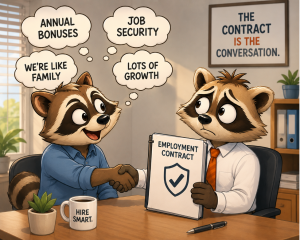
You’re trying to land Bob. He’s good. You want him.
In the interview you say: “We do bonuses every year — everyone gets one. It’s part of the culture here.”
Bob accepts the offer. Signs the contract. Starts Monday.
Two years later, times are tight. You skip the bonus. Bob quits and sues for constructive dismissal — claiming you eliminated a fundamental term of his employment.
You pull out the contract. Bonus isn’t mentioned anywhere.
Bob’s lawyer pulls out his notes from the interview. And an email you sent saying “we take care of our people.”
You don’t have an entire agreement clause.
Bob wins.
An entire agreement clause states that the written contract is the full and complete agreement between the parties — nothing said before or outside the contract is enforceable.
Without one, courts can consider verbal promises made during recruitment, emails and messages sent before the offer letter, representations made in job postings, things said during reference calls or onboarding conversations, and informal commitments made by hiring managers who had no idea they were creating legal obligations.
Most small business contracts don’t include one — or include a watered-down version that doesn’t hold up. It’s the clause that quietly protects you from everything you said before Bob signed.
Courts have found employers bound by verbal bonus promises made in interviews, “we never let good people go” statements implying job security, commission structures described in recruiting emails, role descriptions that expanded the job beyond what the contract covered, and benefits described in conversation but never put in writing.
The threshold isn’t a formal promise. Anything that could reasonably induce someone to accept the job can be characterized as a representation Bob relied on.
He doesn’t need a signed document. He needs to show he made his decision based on what you told him.
Scenario 1: The Bonus Promise
“We pay bonuses based on performance — usually 10 to 15 percent of salary.” Contract says: “Bonuses are discretionary and at the sole discretion of the employer.” Bob gets nothing for two consecutive years. Sues.
Without an entire agreement clause and clear bonus language, courts may find the verbal representation created an enforceable obligation — regardless of what the contract says.
Scenario 2: The “We’re Like a Family” Promise
Recruiter tells Bob: “People stay here for decades. We’re very stable.” Bob leaves a secure job to join. Gets laid off fourteen months later.
Bob claims he was induced to leave stable employment by misrepresentation. Damages aren’t just notice — they can include losses from leaving his prior job. Courts have awarded significant damages in these cases on top of wrongful dismissal pay.
Scenario 3: The Job Description Expansion
Posting said “VP of Sales, managing a team of eight and full P&L responsibility.” Contract says “Senior Sales Manager.” Bob accepted based on the posting.
Court may find he’s entitled to the role described in the ad — not the one that appeared in the contract he signed two weeks later.
Scenario 4: The Offer Email That Created the Contract
Employer sends a detailed offer email outlining compensation, bonus structure, equity, and expanded role. Sends a “formal contract” two weeks later with different terms.
Employee relies on the email. Without an entire agreement clause in the contract, the email terms may govern — and the contract terms that differ from the email may be unenforceable.
A well-drafted entire agreement clause states clearly that the written contract supersedes all prior discussions, representations, negotiations, and agreements — verbal or written. It makes explicit that nothing said before the contract was signed is binding on either party.
It protects you from informal promises made by hiring managers, recruiters, or other employees who were trying to close the deal. It closes the gap between what you said in the interview room and what you agreed to on paper.
It works in conjunction with two companion clauses that every contract should include.
These three clauses work together:
Entire Agreement clause — prior representations don’t count. The contract is the contract.
Amendment clause — future changes must be in writing and signed by both parties. Bob can’t claim you verbally agreed to something after the fact.
Governing Law clause — establishes which province’s employment law applies. Essential for remote employees, employees who move, or businesses operating across provincial lines.
Together they create a clean, closed agreement. Without all three, creative lawyers will find the gaps.
Everything you say in an interview could become enforceable without the right clause in the contract. That means training the people doing your hiring.
Don’t promise guaranteed bonuses — say bonuses are discretionary and subject to the contract terms. Don’t make job security assurances — “we’re a stable company” is fine, “we never let good people go” is a problem. Don’t describe equity or ownership informally — if it’s not in the contract, don’t mention it. Keep offer emails high-level and direct candidates to the contract for the specifics.
The contract should be the source of truth. Not the last document Bob reads before he starts.
Every RascalHR employment contract includes an entire agreement clause, amendment clause, and governing law clause as standard. The trifecta that closes the gap between what you said and what you signed.
What you promise in the interview stays in the interview — not in the courtroom.
Without an entire agreement clause, everything you said to recruit Bob is potentially enforceable.
Courts can and do hold employers to verbal promises, informal emails, and recruiting representations. The fix is simple — one clause in the contract that makes clear the written agreement is the whole agreement.
But only if it’s in the contract before Bob signs.
After he starts, it’s too late.
Make sure your contracts close the door on prior promises →