 Login
Login
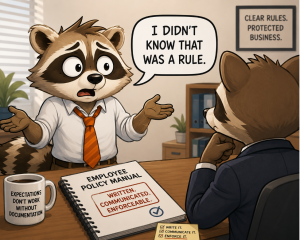
Bob’s been showing up late for three weeks — 15 to 20 minutes, not egregious, but enough to notice.
You pull him aside. “Bob, the lateness needs to stop.”
Bob shrugs. “What lateness? No one told me I had to be here at 9 sharp. The offer letter didn’t say that. There’s no attendance policy.”
You freeze.
Because he’s right.
You never wrote it down. You assumed everyone knew. You figured “9 AM start time” was enough.
Bob just weaponized your lack of documentation. And now you’re stuck enforcing an expectation that was never a policy.
Most small business owners think they have workplace policies. What they actually have are unwritten expectations — and those don’t hold up when Bob pushes back.
Policies are the rules of your workplace. They set boundaries, define acceptable behavior, and protect your business. They’re written, communicated, and enforceable. Example: “Employees must arrive on time. Repeated tardiness may result in disciplinary action up to and including termination.”
Procedures are step-by-step instructions for how things get done. They’re operational, not legal. They can change frequently without triggering compliance issues. Example: “To request time off, submit in the scheduling system 2 weeks in advance.”
Expectations are informal or unwritten norms. They’re often assumed, not communicated. They vary by manager or team. They’re nearly impossible to enforce. Example: “Everyone knows we start at 9 AM.”
Bottom line: If it’s not written as a policy, it’s just an expectation. And expectations give you zero leverage when Bob says “no one told me.”
You told Bob his start time was 9 AM. It’s in the offer letter. But you didn’t define what happens if he’s late. You didn’t communicate attendance standards in writing. You didn’t have him acknowledge a policy.
The “everyone knows” trap looks like this:
“Everyone knows we don’t gossip about coworkers.” Where’s that written?
“Everyone knows you can’t work a competing side hustle.” Did Bob sign a conflict of interest policy?
“Everyone knows we expect professional behavior.” What does that mean? Who defines it?
“Everyone knows you need to give two weeks’ notice.” Actually, employees don’t legally owe notice unless it’s in their contract.
The problem: “Everyone knows” isn’t enforceable. It’s not documentation. It’s not a defense.
Scenario 1: Bob’s Attendance
Bob’s chronically late. You address it. Bob says there’s no attendance policy.
You point to the offer letter: “Start time 9 AM.”
Bob: “That’s my shift start. Doesn’t say consequences for being late. Half the team rolls in at 9:15. Why me?”
No written policy. No consistent enforcement. No documentation. You back off.
Scenario 2: Bob’s Gossiping
Bob’s spreading rumors. Team morale tanks.
You confront him: “This is unprofessional.”
Bob: “How? Where does it say I can’t discuss Sarah?”
No Respectful Workplace Policy. No standards around gossip. Bob keeps talking.
Scenario 3: Bob’s Side Hustle
Bob’s running a competing business, using your client contacts.
You: “You can’t do that!”
Bob: “Why not? No non-solicit. No conflict of interest policy. My own time.”
He’s right — you never had him sign anything. No recourse.
Scenario 4: Bob Quits Without Notice
Bob emails his resignation Friday at 4:46 PM, effective immediately.
You: “You owe two weeks!”
Bob: “Where does it say that? My contract doesn’t mention notice. I don’t legally owe you anything.”
In most provinces, he’s right. You’re stuck.
The pattern: No written policy equals no leverage equals Bob wins.
You can’t discipline Bob for violating a rule that doesn’t exist.
What happens when you try: Bob pushes back — “Show me where that’s written.” You can’t, because it’s not. You escalate anyway — written warning, suspension, termination for cause. Bob lawyers up — claims discipline was arbitrary, inconsistent, or discriminatory. You lose — can’t prove the rule existed, that Bob knew it, or that you enforced it consistently.
Real legal risk: Wrongful dismissal (“Fired for violating a policy I never knew existed”), human rights complaints (“Enforced against me but not others — discrimination”), constructive dismissal (“Suddenly enforcing ‘standards’ never communicated — working conditions changed”).
The cost: Legal fees to defend. Potential damages or settlement. Time, stress, reputational damage. All because you didn’t write it down.
You might think: “I’ll send an email. ‘Hey team, here are the rules.’ Done.”
Not quite.
Verbal communication (or one-off emails) isn’t the same as a policy because: No proof Bob received it — email buried, he says he never saw it. No acknowledgment — Bob can claim he didn’t understand or agree. Not documented as part of the employment relationship — courts expect formalized policies, not Slack messages. Inconsistent application — some people joined after, some missed it.
What you need instead: Written Employee Policy Manual. Signed acknowledgment from every employee. Consistent communication (policies in onboarding, reviews, discipline). Regular updates as laws evolve.
When Bob says “no one told me,” you pull out his signed acknowledgment: “Yes we did. Here’s proof.”
If Bob’s getting away with stuff, you don’t have these in writing:
1. Attendance, Absences & Punctuality Policy — Expectations for showing up on time, how to report absences, consequences for chronic lateness.
2. Respectful Workplace / Anti-Gossip Policy — What “respectful” means, unacceptable behaviors (gossip, rumors, bullying, harassment), how complaints are handled.
3. Code of Conduct — General behavioral standards, professionalism expectations, use of company resources.
4. Conflict of Interest Policy — Restrictions on outside employment and competing activities, disclosure requirements.
5. Technology & Acceptable Use Policy — Rules for company devices, email, internet, monitoring policies, social media conduct.
6. Performance Management & Discipline Policy — How issues are addressed, progressive discipline process, grounds for immediate termination.
7. Resignation & Notice Period Policy — Required notice for resignations, what happens if employee quits without notice, return of company property.
If these don’t exist in writing, Bob can do whatever he wants.
Step 1: Audit What You Have
Do you have a written Employee Policy Manual? Is it up to date? Have employees signed acknowledgment? Are policies enforced consistently?
Step 2: Identify the Gaps
What “rules” are you enforcing that aren’t written? What problems keep coming up with no policy? What did Bob recently get away with because you had no documentation?
Step 3: Create or Update Your Policy Manual
Write clear, enforceable policies. Ensure compliance with provincial Employment Standards Act and Human Rights Code. Use plain language, not legalese.
Step 4: Communicate and Implement
Give employees the updated manual. Have them sign acknowledgment form. Train managers on consistent application. Reference during onboarding, reviews, discipline.
Step 5: Enforce Consistently
Apply the same way to everyone. Document violations and responses. No exceptions for high performers — that’s how discrimination claims start.
It’s risky. If the rule isn’t in a written policy the employee acknowledged, they can argue they never knew it existed. Discipline or termination based on an unwritten expectation can lead to wrongful dismissal, human rights or constructive dismissal claims, because you can’t prove the rule existed, that they knew it, or that you enforced it consistently.
A policy is a written, communicated and enforceable workplace rule, such as an attendance policy with defined consequences. An expectation is an informal, often unwritten norm like “everyone knows we start at 9.” Expectations vary by manager, are assumed rather than communicated, and are nearly impossible to enforce when an employee pushes back.
Usually not. A one-off email or Slack message gives you no proof each employee received it, no acknowledgment, and isn’t documented as part of the employment relationship. Courts expect formal policies. You need a written policy manual, a signed acknowledgment from every employee, and policies referenced in onboarding, reviews and discipline.
Not necessarily. In most provinces, employees don’t legally owe resignation notice unless it’s in their employment contract or a policy they agreed to. If you want notice when someone quits, put a resignation and notice period policy in writing and have employees sign it.
RascalHR’s Employee Policy Manual includes province-specific policies compliant with local Employment Standards Act and Human Rights Code, auto-updated policies as laws change, plain enforceable language (not legalese), and built-in employee acknowledgment forms.
Policies included: Attendance, Absences & Punctuality; Respectful Workplace / Anti-Bullying & Harassment; Code of Conduct; Conflict of Interest; Technology & Acceptable Use; Performance Management & Discipline; and more.
The workflow: Generate custom policy manual in RascalHR. Distribute to employees. Have them sign acknowledgment. File signed copies. Update as laws or business practices change.
When Bob says “no one told me,” you say: “You signed this on [date]. Let’s review it together.”
Every business has unwritten expectations. The question is whether those expectations will protect you when Bob pushes back.
Spoiler: They won’t.
If it’s not written, it’s not a policy. If Bob didn’t sign it, he didn’t agree to it. If you’re not enforcing it consistently, it won’t hold up.
Stop relying on “everyone knows.” Start documenting.
Because the next time Bob says “no one told me that was a rule,” you need to be able to prove that yes, you did.
Stop letting Bob exploit the gaps in your documentation. Get a real Employee Policy Manual →