 Login
Login
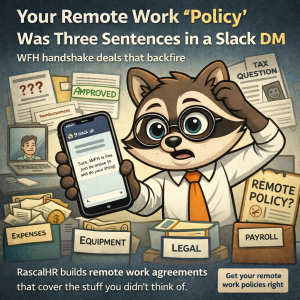
What happens when “just work from home” turns into a tax question, a reimbursed laptop feud, and a compliance headache.
On a Friday afternoon, you sent a quick reply in Slack:
“WFH is fine. Just be online 9–5 and do your thing.”
Harmless, right?
Fast forward three months:
That Slack message? It just became the most expensive sentence in your HR history.
Handshake deals aren’t policies. They’re assumptions with legal consequences.
A real remote work policy isn’t about permission. It’s about structure. It defines who can work remotely, how work is done, how performance is measured, and what guardrails protect both the employee and the company.
Slack DMs don’t cover:
Policies do.
Equipment reimbursement wars
Jan bought a $300 ergonomic chair. Dave wants a standing desk. One team used their stipend, the other didn’t know it existed. Now you’re arbitrating furniture.
Availability vs. autonomy confusion
Your sales rep logs off at 2PM for errands. Your developer is online at midnight. Neither is wrong, but without clear expectations, everyone thinks someone else is slacking.
Where do they actually work?
When someone relocates out-of-province (or out-of-country), you’re on the hook for tax, employment standards, and potential compliance audits. If your payroll team is in the dark, you’re already behind. As well, you need a policy manual that incorporates all of the provincial legislation from each province that employees live in.
Security blind spots
Your ops lead is working from a public cafe. No VPN. Shared home computer. That client file? Probably backed up to their Google Drive.
This isn’t just a nice-to-have. It’s table stakes for modern compliance.
Eligibility & Scope
Work Hours & Communication
Equipment & Reimbursement
Privacy & Data Security
Performance & Accountability
Compliance & Location Rules
Consequences for Violations
Letting someone work from home without documentation is like hiring without a contract. It might work… until it doesn’t. Then it’s messy, expensive, and your fault.
RascalHR builds remote work agreements that:
Your team deserves clarity. You deserve coverage.