 Login
Login
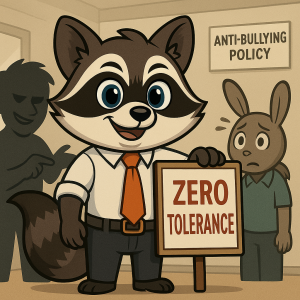
Workplace bullying isn’t always the red-faced manager screaming in someone’s face. Sometimes it’s subtler — the sarcastic comment in a meeting, the “just joking” dig that lands like a punch, or the constant eye-rolls that make people shrink into their chairs.
Meet Bob. Every company has (or had) a Bob. He’s sarcastic, cutting, and thinks tearing people down is just “being honest.” The problem? Bob’s behaviour is bullying — and if you don’t shut it down, you’re not just tolerating it, you’re endorsing it.
That’s why every employer needs a clear, enforceable Anti-Bullying Policy. Done right, it protects your people, your culture, and your bottom line.
Bullying is bigger than raised voices. It’s about repeated behaviour that humiliates, intimidates, or undermines someone.
Bob doesn’t yell. He just “critiques” loudly in meetings, mocks coworkers under his breath, and uses sarcasm as a weapon. He might even claim he’s “raising standards” — but what he’s really raising is turnover.
Your Anti-Bullying Policy should spell out that bullying includes:
If your policy only covers “don’t scream at people,” you’ve left the Bobs of the world free to do real damage.
Bob’s favourite defence? “I was just joking.” But sarcasm isn’t harmless when it undermines a colleague’s work or confidence. Over time, these microaggressions do more damage than one heated argument.
Employees subjected to constant digs and “jokes” eventually shut down. They stop sharing ideas, avoid speaking up, and check out of the culture altogether.
🦝 Rascal Tip: If the joke leaves one person laughing and another shrinking, it’s not a joke. It’s bullying.
Here’s the kicker: if Bob’s behaviour is reported and leaders shrug it off, the message is crystal clear — bullying is tolerated here.
Employees notice. They think: If Bob gets away with it, what’s the point of reporting? Pretty soon, your culture is one big inside joke at someone else’s expense.
A strong Anti-Bullying Policy makes it clear that ignoring bullying is as serious as committing it. Managers don’t get a pass.
Lots of businesses technically “have” an Anti-Bullying Policy. It’s in a binder. Or buried in a folder nobody’s opened in years. Bob loves those workplaces — because he knows nothing will actually happen.
An effective policy is:
If your team doesn’t know the policy — or doesn’t believe you’ll enforce it — then it may as well not exist.
Bullying thrives when consequences are slow or inconsistent.
Bob knows how to push boundaries. He’ll test leadership with “little” comments to see if anyone reacts. If leaders ignore it, Bob escalates.
The fix? Progressive discipline that’s documented and consistent.
🦝 Rascal Tip: Bob won’t stop unless you make him. Consequences change behaviour. Excuses don’t.
Policies and consequences are vital, but employees also need tools to deal with Bob in real time. Training should include scripts like:
These empower employees to push back without escalating. Over time, the culture shifts. Bob stops being the loudest voice in the room — and starts being the most uncomfortable.
Here’s the truth: most people don’t want to be the one who “tattled” on Bob. If they don’t trust leadership to protect them, they’ll just put up with it — and resentment grows.
That’s why your Anti-Bullying Policy should guarantee:
Confidential reporting channels
Protection from retaliation
Clear timelines for investigation and response
If reporting bullying feels riskier than staying quiet, Bob wins.
Bob doesn’t just annoy people. He drives them out the door. Talented employees won’t stick around in a toxic environment where sarcasm and humiliation are tolerated.
A zero-tolerance stance isn’t about being harsh. It’s about protecting the employees who actually want to contribute. Businesses with strong Anti-Bullying Policies see:
Repeated behaviour that humiliates, intimidates or undermines someone. That includes verbal abuse like sarcasm, insults and name-calling, public shaming or constant nitpicking, excluding people from meetings or projects, spreading rumours, and withholding information to set someone up to fail. It doesn’t have to involve yelling.
It can be. Sarcasm that undermines a colleague’s work or confidence isn’t harmless, and over time constant digs do more damage than one heated argument. A simple test: if the joke leaves one person laughing and another shrinking, it’s not a joke. It’s bullying.
A clear definition of bullying beyond yelling, plain language that’s easy to find, training that backs it up, and documented, consistent progressive discipline. It should also guarantee confidential reporting channels, protection from retaliation and clear timelines for investigation, and make it clear managers can’t ignore reports.
Bob isn’t funny. He’s not “just sarcastic.” He’s a bully. And ignoring him is the fastest way to lose good people.
A strong, enforced Anti-Bullying Policy is how you draw the line. Zero tolerance for bullying = maximum impact for trust, morale, and performance.
So next time Bob makes a “joke” at someone else’s expense? Remember the simplest (and strongest) response:
“We don’t do that here.”
👊 Ready to stop Bob before he drives your best people out the door?
RascalHR gives you a clear, compliant Anti-Bullying Policy that’s ready to publish — plus the tools to enforce it. Log in today and put it to work.