 Login
Login
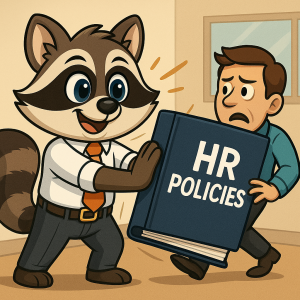
Every company has a Bob. You know the type: he skims the employee handbook once, signs the acknowledgment form, and then does whatever he wants. When called out, Bob shrugs and mutters, “This doesn’t apply to me.”
And here’s the uncomfortable truth: he’s usually right. Not because the rules don’t exist, but because nobody enforces them. That’s how HR policies fail — not on paper, but in practice.
Here’s how to fix that, and finally take away Bob’s favourite excuse.
Bob loves binder policies. They’re long, boring, and written in legalese nobody understands. Best of all, nobody ever checks if he follows them.
That’s the problem with “binder-only” rules:
???? Rascal Tip: If Bob can say “I didn’t know that was a rule,” your policy is failing.
Bob thrives on ambiguity. If a policy takes five paragraphs to explain, he’ll happily twist it to suit himself.
The fix? Write policies in plain English, short enough to remember, and specific enough that Bob can’t wiggle out.
If an employee can explain the rule in under 30 seconds, you’ve written it well. If not? Bob will exploit it.
Bob’s favourite line: “I signed it once during onboarding. I know what I’m doing.”
Reality check: he doesn’t. Or worse, he does — and he’s ignoring it.
Policies only stick if you train people on how to apply them:
Signatures prove nothing. Training creates accountability.
Walk into Bob’s office and you’ll see your company’s values poster hanging crookedly on the wall. He’s the first to roll his eyes at “Integrity” and “Respect.” Posters don’t scare Bob.
Values only matter if they show up in behaviour. That’s where policy comes in. A Respectful Workplace Policy turns “respect” into action. An Anti-Bullying Policy turns “integrity” into accountability. A Termination Policy ensures consequences are clear.
If values stay on the wall, Bob will keep laughing at them.
Bob has one question: “What happens if I ignore this?”
If the answer is “nothing,” then congratulations — your HR policy has failed.
An effective policy framework includes:
???? Rascal Tip: Bob doesn’t need harsher rules — he needs proof you’ll enforce the ones you already have.
Bob knows HR only shows up once in a while. That’s why he tests his managers every day. If they look away, he takes that as permission.
Managers have to:
If managers dodge conflict, Bob runs the show.
Want to know if your policies are failing? Watch Bob. He’ll tell you.
The second Bob smells weakness, your policy is toast.
Here’s how you beat the “this doesn’t apply to me” mindset:
Policies that live in conversation — not just in binders — are the ones that stick.
Bob will always test the system. The only question is: will your HR policies hold up, or will he prove they’re optional?
Policies don’t fail because they’re bad. They fail because people like Bob learn they don’t matter. Write them clearly, train them consistently, and enforce them fairly — and suddenly Bob’s favourite excuse disappears.
Because the strongest message you can send isn’t in a binder. It’s in action.
???? Tired of Bob thinking the rules don’t apply to him?
RascalHR gives you clear, compliant HR policies that are built for real life — not binders.
Log in today and bring your policies to life.