 Login
Login
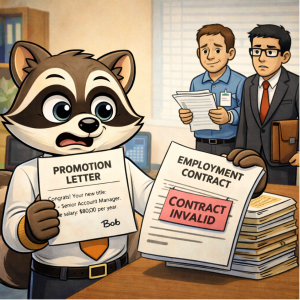
You promoted Bob six months ago. Gave him a raise, a new title, more responsibility. You sent him a nice email congratulating him on the promotion.
Fast-forward to today: you let Bob go. Hand him the severance outlined in his original employment contract. Done.
Two weeks later, Bob’s lawyer sends you a letter.
Your termination clause? Worthless. Bob’s entitled to common law notice — potentially 12+ months instead of the 8 weeks you paid.
That promotion letter you sent? It just invalidated your contract.
Salary and promotion letters confirm a change — new title, new pay, new responsibilities. They’re usually short, informal, congratulatory. They don’t replace or update the original employment contract.
Updated employment contracts replace or amend the full agreement. They reaffirm all enforceable terms: termination, confidentiality, IP, non-solicitation. They ensure the contract still reflects the current employment relationship.
The gap? Most small business owners send promotion letters and think they’re done. They’re not. The old contract is still in force — except now it might not apply.
Canadian courts recognize the “changed substratum doctrine” — if an employee’s role changes significantly, the foundation of the original contract erodes. Courts will find the old contract no longer applies because it wasn’t contemplated when signed.
In Celestini v. Shoplogix, a CTO’s responsibilities expanded dramatically over 12 years. The court ruled the 2005 contract no longer applied. Termination clause: invalid. Result: common law notice owed.
What counts as significant change: promotion from individual contributor to manager, substantial salary increases (like doubling over time), major expansion of duties and decision-making authority, taking on P&L responsibility, client management, or strategic leadership.
What doesn’t count: incremental changes within the same role, normal salary increases tied to performance, minor adjustments to duties.
You promote Bob. You send him an email: “Congrats! You’re now Senior Account Manager. New salary: $85K. Effective immediately.”
Bob accepts. Starts working in the new role.
What just happened legally: You unilaterally changed the terms of employment. The email doesn’t reference or update the original contract. It doesn’t reaffirm termination clauses, IP ownership, confidentiality, or non-solicitation. The substratum of Bob’s employment has changed, but the contract hasn’t.
The exposure: If you fire Bob later, he argues the original contract no longer applies. No valid termination clause means common law notice — potentially 10 to 18 months for a senior employee. The “promotion email” becomes evidence that his role fundamentally changed.
What you should have done: Provided Bob with an updated employment contract that includes the promotion terms AND reaffirms all the protective clauses.
An anti-obsolescence clause states that the contract remains enforceable despite changes to title, salary, duties, or responsibilities. Sample language: “The terms of this Agreement which are not Employee-specific and which are intended to continue governing the Employer/Employee relationship will continue to do so regardless of any changes to the Employee’s position, pay, schedule, location, duties, benefits, vacation entitlements, bonus entitlements, or any other variable terms of employment and regardless of whether such change(s) is/are material or otherwise.”
In LaPlume v. AAA Internet Publishing, a BC court upheld a termination clause despite promotions and salary doubling over nine years. Why? The contract included an anti-obsolescence clause.
But they’re not bulletproof. If the role change is too dramatic — cashier promoted to VP of Operations — courts may still find the contract obsolete. If the change clause is vague or poorly drafted, it won’t hold up. Courts will still scrutinize whether the changes were within the reasonable contemplation of the parties when the contract was signed.
Best practice: Include anti-obsolescence language in every employment contract. Then update the contract anyway when major changes happen.
“We gave Bob a raise and a new title. He’s happy. We’re good.” Not if the original contract doesn’t account for the change.
“We sent him a promotion letter. That’s legally binding, right?” It’s binding for the promotion terms. It doesn’t update or replace the rest of the contract.
“The contract says he’s a [original title]. He’s now a [new title]. Courts will understand it’s the same job.” Courts won’t assume that. If the roles look different, they’ll treat them as different.
“We’ve used the same contract template for years. We just promote people when they deserve it.” Every promotion without an updated contract is a ticking time bomb.
If you promote Bob and later try to demote him back or reduce his responsibilities, you’ve created a constructive dismissal claim. Why? You can’t unilaterally change terms of employment to Bob’s detriment.
In Parks v. Vancouver International Airport Authority, an employee was unilaterally promoted — more staff, new compensation plan, different hours. He didn’t want the promotion. The court ruled it was constructive dismissal. He was entitled to severance.
The takeaway: Promotions aren’t just “good news.” They’re material changes to the employment relationship. If you don’t handle them properly, they create legal exposure on both ends: termination AND future changes.
Step 1: Draft an updated employment contract that reflects the new role, salary, and responsibilities.
Step 2: Provide “fresh consideration” — the promotion and raise count, but document it clearly.
Step 3: Include all protective clauses: termination, confidentiality, IP, non-solicitation, probation period for the new role.
Step 4: Have Bob sign the new contract before the promotion takes effect.
Step 5: Keep a copy in his file and confirm in writing that this contract replaces the prior agreement.
What happens if Bob refuses to sign? You can proceed with the promotion under the old contract (but you lose the protection of updated terms). You can negotiate. You cannot threaten to fire him if he doesn’t sign — that’s duress and makes the contract unenforceable.
RascalHR employment contracts include anti-obsolescence clauses as standard.
When you promote someone, Rascal guides you through creating an updated contract that reflects the new role and compensation, reaffirms all protective clauses (termination, IP, confidentiality, non-solicitation), and ensures legal compliance with current employment standards.
No templates. No guesswork. Just contracts that actually hold up when you need them.
The contract you sign on day one protects you on the last day — but only if you update it when the job changes.