 Login
Login
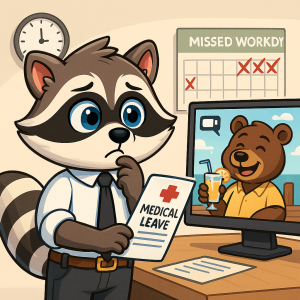
Bob’s been out on medical leave for four weeks.
His original note said “stress-related illness.” No return date. No check-ins. No updates.
Last Friday, your ops manager spotted him on Instagram — smiling on a dock, holding a caesar, clearly not wearing stress.
Now you’re stuck. You don’t want to question someone’s medical situation. But you’re also the one juggling team coverage, a delayed client project, and an inbox full of “any update on Bob?”
Welcome to the tightrope walk of managing leaves.
Let’s get this out of the way: medical leaves are real. Stress is real. Invisible disabilities are real. This post isn’t about doubting Bob’s experience.
It’s about what happens when your business is left in the dark.
Most small businesses want to do right by their people. But they don’t have the infrastructure — or frankly, the HR depth — to handle medical leaves well. So they guess. Or they ignore. Or they hope it works out.
Which is exactly how good intentions turn into legal messes.
Here’s the brutal reality: most medical notes are vague.
“Unable to work due to a medical condition. TBD on return.”
That’s it. And guess what? In many provinces, that’s legally sufficient.
But here’s what you can request (and should):
What you can’t ask for:
Push too hard, and you risk a human rights complaint. Push too little, and you’re left with coverage gaps and zero timeline.
Sound fun yet?
Bob might be completely above board. But if your process is chaotic, inconsistent, or nonexistent, you’re the one creating exposure — not him.
Here’s what we see all the time:
And if someone does challenge how their leave was handled?
Good luck proving you weren’t being discriminatory if nothing’s written down.
You don’t need to be a lawyer or a medical expert.
You just need a system.
That starts with a policy.
A good sick leave or medical leave policy sets the expectations — for the employee, the manager, and the company. It outlines what documentation is needed, what timelines look like, and how return-to-work is handled.
That way, when someone goes off, you’re not building the plane mid-flight.
Rascal provides the core leave policy templates every small business in Canada should have — fully editable, clear, and human.
We don’t:
But our templates will make it a hell of a lot easier to:
Taking leave shouldn’t be a guessing game — for the employee or the employer.
With a clear policy in place, you don’t have to improvise. You don’t have to chase people awkwardly. And you don’t have to feel like the villain for wanting an update on someone who’s been out of office for a month and still shows up in group chats from a fishing boat.
You can set boundaries.
You can build trust.
And you can do both with a little help from Rascal.