 Login
Login
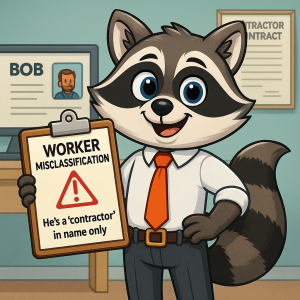
Bob is technically a contractor.
He signed a contractor agreement. He sends you monthly invoices. You told him from day one he’s not on payroll, not eligible for benefits, and not part of the company.
But Bob also:
And now that you’ve paused the project, Bob’s lawyer is asking about termination pay.
Welcome to the world of contractor misclassification, tech startup edition.
Startups love contractors. They’re fast, flexible, and they don’t trigger all the messy backend stuff like payroll, benefits, and internal approvals.
And if you’re building a product, launching a feature, or scrambling to hit investor milestones, people like Bob are gold. He’s a pain in the ass, sure. But he knows the codebase inside out. No one else can untangle the spaghetti he wrote at 2am last March.
So you bring him in. You skip HR. You call it a contract. Everyone wins.
Until someone gets hurt. Or leaves. Or gets cut loose. That’s when you find out the CRA, the ESA, and the courts don’t care what you call Bob. They care about what his working relationship actually looks like.
Mike here!
We’ve worked in this space. We’ve been the contractor. We’ve seen the inside.
It wasn’t a loophole. It was a deliberately structured setup to stay legit.
But even then? We’ve had colleagues audited. More than once.
We’ve seen companies get reclassified years after the contract ended. And we’ve watched well-meaning founders get blindsided by penalties because they treated a contractor like a team member “just temporarily.”
The CRA doesn’t care that it was flexible. Or friendly.
They care whether it looks, smells, and operates like employment.
If it does, you’re exposed.
Here’s what Canadian regulators look at when deciding if Bob is a real contractor or just an employee in disguise:
You could have a beautifully worded contractor agreement, and still be on the hook if Bob’s actual work life says “employee.” Form matters. But function wins in court.
The short version? It gets expensive. Fast.
If the Ministry of Labour gets involved, you might also owe notice or severance under employment standards. And if Bob sues for wrongful dismissal? You’re looking at common law notice — which could be months of pay.
This isn’t theoretical. The CRA audits “contractor-heavy” companies regularly. Especially tech companies.
These might sound familiar:
“He’s a contractor, but he’s part of the Slack channels and standups.”
“We gave him a team email to make it easier to loop him in.”
“Yeah, he works full-time hours, but it’s only for six months.”
“We plan to bring him on full-time once we close the next round.”
Intentions don’t count. Execution does.
Some of these, like the slack channels, even the full time for six months, are totally fine in the right situations. We’ve all hired contractors for our business or done staff augmentation. You just have to make sure it’s clear that it’s fixed term (and not extended forever).
It’s not about never hiring contractors. It’s about using them properly.
If you’re not sure whether your “contractors” pass the smell test, it’s time to find out.
Rascal gives you:
Because once Bob’s building your product, joining your all-hands, and pulling code reviews with your dev lead… it’s already too late to pretend he’s just “external support.”