 Login
Login
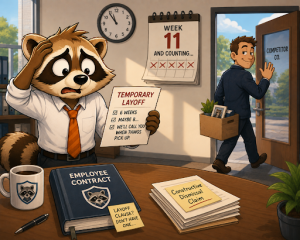
Business was slow. You needed to cut costs. You told Bob it was temporary — six weeks, maybe eight. You’d call him back as soon as things picked up.
Bob said he understood. Packed up his desk. Went home.
Twelve weeks later, Bob’s lawyer sends a letter.
Bob didn’t wait for the recall. Bob filed for constructive dismissal. Bob wants eight months of severance — retroactive to the day you sent him home.
But it was a temporary layoff. We told him it was temporary.
Here’s what you didn’t know: in most of Canada, you don’t have the automatic right to lay someone off temporarily. And if you do it without that right clearly established in the employment contract — Bob was never on a temporary layoff.
He was terminated. On day one.
Most employers assume temporary layoffs are a standard tool. Available to any business, any time, for any reason.
They’re not.
Unlike the US — where temporary layoffs are widely accepted — Canadian common law treats a unilateral layoff as a fundamental change to the employment relationship.
Which is another way of saying: constructive dismissal.
Unless Bob agreed to the possibility of a layoff when he was hired — in writing, in his employment contract — you generally don’t have the right to impose one. Not temporarily. Not at all.
But we’ve done this before and nobody complained.
Doesn’t matter. An employee who accepts a layoff without objecting hasn’t necessarily waived their rights. They may just be waiting. Building a constructive dismissal claim while you assume everything’s fine.
Bob’s patient like that.
Even when you do have the right to lay Bob off — because it’s in the contract, or because it’s standard practice in your industry — the clock starts the moment he walks out the door.
And it runs out faster than most employers realize.
Here’s where the limits land by province:
Ontario: 13 weeks in any 20-week period without benefits continuation. Up to 35 weeks in a 52-week period if you keep paying substantial benefits. There’s also a newer extended option — up to 52 weeks in a 78-week period — but it requires Bob’s written consent, a firm recall date, and government approval. Miss any of those conditions and the layoff is deemed a termination, retroactive to Day 1.
British Columbia: 13 weeks in a 20-week period. Same basic structure. Exceed it and Bob’s employment is deemed terminated.
Alberta: 90 days in a 120-day period. One of the shorter windows — and one of the most commonly exceeded.
Manitoba: 8 weeks in a 16-week period. Shorter still.
Saskatchewan: Layoff status kicks in after any interruption exceeding 6 working days. Deemed termination rules apply after that.
The numbers aren’t the same across the country. Bob sitting at home in Burnaby has different rights than Bob sitting at home in Calgary. If you’re not sure which rules apply — especially for remote employees — don’t guess.
Meanwhile, Bob is at home. Counting the weeks. Talking to his cousin who went through something similar. His cousin told him to call a lawyer after week ten.
Bob called at week eleven.
When the clock runs out, the layoff doesn’t just become invalid going forward.
It becomes a termination retroactive to the first day.
That means whatever notice and severance Bob is entitled to — he’s owed it calculated from the day you sent him home. Not the day the limit expired. Not the day his lawyer sent the letter.
Day one.
Bob worked for you for six years. You laid him off in January. The clock ran out in April. You owe him six years of termination entitlements — starting from January.
And that’s just the ESA floor.
Common law notice sits on top. Courts have found that layoffs which technically comply with provincial ESA rules can still constitute constructive dismissal at common law — meaning Bob can claim months of additional severance beyond what the statute requires.
Comply with the rules and still owe common law notice. Not a typo. That’s Canadian employment law.
The protection against all of this is a temporary layoff clause. In the employment contract. Signed before Bob’s first day.
A properly drafted layoff clause gives you the contractual right to temporarily reduce or eliminate Bob’s hours without it being treated as constructive dismissal. It tells the court that Bob knew, when he was hired, that a layoff was a possibility — and agreed to it.
Without that clause, you’re relying on industry custom (hard to prove in most sectors outside construction and film) or hoping Bob’s silence counts as consent.
It doesn’t.
The clause needs to be:
No clause. No right. No “temporary” about it.
Between 2020 and 2022, hundreds of thousands of Canadian employees were placed on temporary layoffs. Many exceeded provincial limits. Most employers had no layoff clause.
Courts were briefly sympathetic to employers navigating an unprecedented situation.
That era is over.
If you laid people off during COVID and re-hired them — without a new contract, without a layoff clause — you may have employees right now who were technically terminated and re-hired, with continuous service claims intact, and still nothing in their contract protecting you if it happens again.
The pandemic created a lot of messy employment relationships that nobody cleaned up. Check your files.
Here’s a scenario that catches employers off guard.
You recall Bob within the permitted timeframe. Written notice, proper recall. Bob says no.
If Bob refuses without reasonable cause, his ESA termination entitlements are typically extinguished. He walked away.
Except — reasonable cause matters.
If the role you’re recalling him to is materially different from the one he left — different pay, different hours, different responsibilities — Bob may have grounds to refuse and still claim constructive dismissal.
A recall to a lesser role isn’t a recall. It’s a demotion in disguise.
Put the exact terms in writing before he responds. Document what you’re offering. Because if Bob refuses a legitimate recall, you’re protected. And if he refuses a diminished one, he might still be right.
Check your contracts first. Do you have a layoff clause? Is it actually compliant? If not — get one in place for every new hire from this point forward. And take a hard look at how to address existing employees.
Know your province’s rules. Which ESA governs? What’s the maximum duration? Do you need to continue benefits to access the extended period? Don’t assume your rules are the same as the province next door.
Put the layoff in writing. Expected duration. Recall process. Benefits continuation (if applicable). Bob needs to know where he stands — and so do you, for the paper trail.
Track the clock like it matters. Because it does. Assign someone to watch the calendar against the provincial limit. The deemed termination doesn’t wait for you to notice.
Recall properly. Written notice. Original role, original compensation, or equivalent. Keep everything documented. Bob refusing a proper recall is his problem. Bob refusing a diminished recall might still be yours.
When you’re approaching the limit and can’t recall yet, get legal advice before the clock runs out. Your options shrink dramatically once deemed termination kicks in. Don’t wait until you’re past the deadline to ask what to do about it.
Only if you have the right to. In most of Canada, a unilateral layoff is treated as constructive dismissal unless the employee agreed to the possibility in writing, usually through a layoff clause in the employment contract, or it’s standard practice in your industry. An employee accepting a layoff without objecting doesn’t necessarily waive their rights.
It depends on the province. Ontario allows 13 weeks in any 20-week period, or up to 35 weeks in 52 with substantial benefits continued. British Columbia allows 13 weeks in 20, Alberta 90 days in 120, and Manitoba 8 weeks in 16. Exceed the limit and the layoff is deemed a termination.
When a layoff exceeds the provincial limit, it’s deemed a termination retroactive to the first day of the layoff. Notice and severance are owed from the day the employee was sent home, not the day the limit expired. Common law notice can also be owed on top of the ESA minimums.
If the employee refuses a proper recall without reasonable cause, their ESA termination entitlements are typically extinguished. But if the recall is to a materially different role, with different pay, hours or responsibilities, the employee may have grounds to refuse and still claim constructive dismissal. Put the exact terms in writing.
Every RascalHR employment contract includes a properly drafted temporary layoff clause — province-specific, ESA-compliant, and established clearly at the point of hire.
Not scrambled together when business slows and you’re hoping Bob doesn’t know his rights.
Bob knows his rights. He called his lawyer at week eleven.
The clause you need is the one you put in before you need it.
A temporary layoff is not a universal employer right in Canada. It’s a right you have to establish — in writing, before the layoff happens.
Without it, Bob was terminated the day he packed up his desk.
With it, you have a legitimate, time-limited option for managing your workforce through downturns — without triggering the severance bill you can’t afford.
The clock starts on Day 1. The limits vary by province. The deemed termination, when it comes, is retroactive.
And Bob? Bob is patient.
Make sure your employment contracts include a proper layoff clause →