 Login
Login
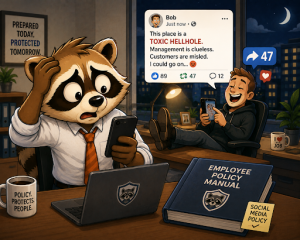
It’s 11 PM on a Tuesday.
Your operations manager sends you a screenshot with one line: “Have you seen this?”
Bob — your Bob, four years, decent employee, no major issues — has posted a thread on his personal account. Calling your business a “toxic hellhole.” Named your manager by name. Said customers are being misled. Sprinkled in a few words your mother wouldn’t approve of.
It already has 47 shares.
You stare at your phone.
It’s his personal account. He posted it on his own time. There’s nothing we can do.
Maybe. Maybe not. But “personal account” isn’t the shield Bob thinks it is — and how much leverage you have depends almost entirely on what’s in your policy manual and what Bob signed when he started.
Let’s figure out what you’re actually working with.
Employees have a right to a life outside work. Off-duty conduct is generally their own business. Courts don’t let employers police what their people do on weekends.
But social media isn’t a private conversation. And the moment Bob’s post connects — directly or indirectly — to the fact that he works for you, the wall between personal and professional starts to crumble.
Courts don’t ask “did he post this from the office?” They ask whether there’s a sufficient connection between what he said and the employment relationship.
Bob muttering “my boss is an idiot” on a locked account with fourteen followers who don’t know where he works? Probably nothing you can do about that.
Bob posting a thread calling your business fraudulent, tagging your company account, from a profile that lists his employer as you, while 47 people share it in your client’s feeds?
That’s a different Tuesday night.
Canadian courts have landed on a consistent set of questions when off-duty conduct lands on their desk. Bob’s post needs to clear at least one of these. The more it clears, the stronger your position.
Reputational harm
The post damaged your business in a real, demonstrable way. Not “this made us uncomfortable.” Actually demonstrable. Clients saw it and called. A partner emailed. The comments section became a disaster you’re now managing.
The test courts use: would a reasonable, fair-minded person — knowing what Bob said and who he works for — conclude that his continued employment would damage your reputation to the point of making the relationship untenable?
47 shares on a Tuesday night may not clear that bar. A story picked up by local media, three client cancellations, and a Google review referencing Bob’s post? Probably does.
Bob is refreshing his notifications. He thinks this is blowing over.
Inability to do the job
Bob’s post makes it functionally impossible for him to keep doing his work.
He’s your head of customer relations. He just called your customers idiots. He can’t credibly represent you to those people anymore. The role is broken. That’s a legitimate ground — and courts understand.
Destroyed workplace relationships
Bob’s post didn’t just offend people. It created a situation where coworkers refuse to work with him, or where the team is now fractured in ways that affect how you operate. Not theoretical discomfort. Real, documented breakdown.
Criminal conduct
Bob’s post included threats. Harassment. Defamation serious enough to attract liability. This is the clearest path to just cause, and the one courts will uphold fastest. If Bob crossed into criminal territory, the conversation changes significantly.
The further his post is from these four grounds, the weaker your hand. Know where you actually stand before you do anything.
Just cause means you terminate Bob with no notice, no severance, nothing. You’re saying what he did was so serious it fundamentally destroyed the trust between you.
Courts are skeptical of just cause at the best of times. For off-duty social media conduct, they’re particularly skeptical — because the principle that employees have a private life is deeply embedded in Canadian employment law.
A negative post that’s vague? Probably not just cause.
Offensive but untraceable to your business? Probably not just cause.
Embarrassing but no measurable harm? Probably not just cause.
And here’s the part that stings: if you terminate Bob for cause and the court disagrees, you don’t just owe what you would have owed him anyway. You may face additional exposure because you denied him severance he was entitled to. Asserting cause that doesn’t hold up makes everything worse.
Before you pull that trigger, call your lawyer.
Bob, meanwhile, has just hit 200 shares. He’s feeling pretty good about himself.
Good news: you don’t have to prove just cause to act. You have options.
Investigate. Before you do anything else, investigate. Document what you found, when you found it, and what steps you took. This protects you regardless of what comes next.
Issue a written warning. The post is problematic but not termination-worthy. A formal warning puts Bob on notice, creates a paper trail, and establishes that future similar conduct will have bigger consequences. This is also what makes the next incident actionable.
Terminate without cause. You want Bob gone. You’re not sure you can prove just cause. Terminate him properly — with notice or severance — and move on. A clean exit beats a messy just cause termination that gets challenged and costs you more.
Enforce your social media policy. Which brings us to the part that changes everything.
Here’s the uncomfortable truth sitting behind the screenshot.
If you have a clear, signed social media policy — one Bob acknowledged when he was hired — you’re in a completely different position.
Without a policy: you’re arguing about principles, hoping courts land where you need them to, and defending decisions you made reactively at midnight.
With a policy: Bob crossed a defined line he agreed to when he took the job. That’s the difference between a difficult conversation and a defensible termination.
What your social media policy actually needs to say:
And then — this is the part most employers skip — Bob signs it. At hiring. In writing. And again when the policy gets updated.
“Bob signed this” is the difference between enforcing a policy and having an argument about whether he even knew one existed.
Bob knew. He signed it. It’s in his file.
That’s the position you want to be in at 11 PM on a Tuesday.
Not every angry post clears the bar. Courts look at specifics. Here’s what strengthens your case and what doesn’t.
Strengthens your case: Bob named your business explicitly. Made factually false statements about your products or services. Named and targeted specific colleagues. The post was shared widely and generated documented client reactions. He included screenshots of internal information. It attracted media coverage.
Weakens your case: The post is vague and untraceable to your business. It’s emotional but not specifically harmful. It was deleted quickly with minimal reach. It’s part of a broader industry rant that doesn’t single you out.
The screenshot your operations manager sent at 11 PM — where does Bob’s post actually land? That’s the honest question that determines your options.
Sometimes. It depends on what the employee said, how many people saw it, whether it caused measurable harm, and whether you have a policy covering it. Courts ask whether there’s a sufficient connection between the post and the employment relationship. A post on a personal account isn’t automatically off limits.
Employees have a right to a life outside work, and off-duty conduct is generally their own business. But once a post identifies or connects to the employer, by naming the business, tagging it or coming from a profile that lists it, it can become grounds for discipline, especially when a signed policy covers it.
Rarely. Courts are particularly skeptical of just cause for off-duty social media conduct. Vague posts, posts untraceable to the business, or embarrassing posts without measurable harm usually aren’t enough. Threats, harassment or serious defamation are the clearest path. If cause doesn’t hold up, denying severance can create additional exposure.
It should cover posts that identify the business directly or indirectly, whenever they’re made and from any account. It should name violations such as disclosing confidential information, false statements, harassing colleagues or bringing the company into disrepute, and set consequences up to termination. Employees should sign it at hiring and again when it’s updated.
RascalHR’s Employee Policy Manual includes a social media and online conduct policy — drafted to current Canadian standards, covering personal accounts and off-duty conduct, built to hold up when you actually need to enforce it.
Not assembled at midnight when the screenshot arrives.
Bob posts at 11 PM on a Tuesday. You open his file. His signed acknowledgment is right there. You know exactly what he agreed to. You know exactly what your options are.
You call your operations manager back.
“We’ve got this. Here’s what we’re doing tomorrow morning.”
That’s the position you want to be in.
Can you fire Bob for a social media post? Sometimes. It depends on what he said, how many people saw it, whether it caused measurable harm, and — critically — whether you have a policy that says what happens when he does exactly this.
“It’s his personal account” evaporates the moment the post connects to your business.
Just cause is a high bar. If you can’t clearly understand it, don’t assert it.
But the employer with a signed social media policy isn’t having the same panicked Tuesday night as the one without.
One of them is calling a lawyer at midnight.
The other one already knows what to do.