 Login
Login
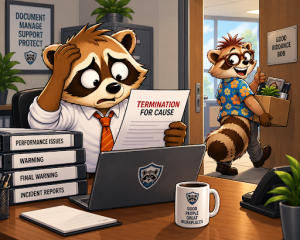
Bob had it coming.
Late constantly. Attitude with the clients. That incident in March you documented. Another one in June. Then last Tuesday — he mouthed off to your manager in front of the whole team.
That was it. You’d had enough. You called Bob into your office and told him he was done. Terminated for cause. No notice. No severance. He earned this.
Bob cleaned out his desk and left.
Three weeks later, his lawyer’s letter arrives. Bob is claiming wrongful dismissal. He wants eight months of severance.
He was terrible. Everyone knew it. We had every reason.
Maybe you did. But “every reason” and “just cause” are not the same thing in Canadian employment law. And the gap between them is where your money goes.
Courts don’t use this phrase — employment lawyers do. But it captures the stakes accurately.
Just cause termination means you end Bob’s employment with no notice, no severance, no payment of any kind. You’re telling a court: what Bob did was so serious, so fundamentally destructive to the employment relationship, that continuing to employ him for even one more day was impossible.
That’s a high bar. Higher than most employers realize when they’re standing in the moment, furious about Tuesday’s incident.
The Supreme Court of Canada established in McKinley v. BC Tel that just cause requires a contextual, proportionality analysis. The question isn’t simply whether Bob did something wrong. The question is whether dismissal — with zero compensation — was a proportionate response given the seriousness of his conduct, his length of service, his employment record, and all the surrounding circumstances.
Bob doing something wrong isn’t enough. Bob doing something wrong badly enough to justify the most severe response in employment law — that’s the test.
There are two paths to just cause. Most employers confuse them.
Path 1: Single serious incident — immediate termination.
Some conduct is so severe that one incident destroys the employment relationship completely. No warning required. No progressive discipline. Bob is done.
This includes: theft or fraud, serious workplace violence, sexual harassment, gross insubordination, serious safety violations that put others at risk, major breach of fiduciary duty, or deliberate destruction of company property.
The common thread: these aren’t mistakes. They’re fundamental betrayals of the trust the employment relationship is built on. A court can look at them and say yes — no reasonable employer would be expected to continue employing this person.
Path 2: Pattern of misconduct — progressive discipline leading to termination.
This is where most just cause cases actually live. And this is where most employers blow it.
Bob is chronically late. Bob’s attitude is a problem. Bob’s performance is consistently below standard. Bob ignores your instructions. None of these things, individually, are typically sufficient to justify immediate termination for cause.
But a documented pattern of the same behaviour — warned, given a chance to improve, warned again, still not improving — can get you there. Slowly. Deliberately. With paper.
That’s progressive discipline. And without it, Path 2 doesn’t exist.
Here’s the thing about Bob’s pattern of lateness, attitude, and that incident in March.
If you didn’t document it properly — warning issued, Bob acknowledged it, clear consequences stated for future occurrences — it doesn’t count. Not in a courtroom.
Progressive discipline isn’t just an HR concept. It’s the legal mechanism that converts Bob’s ongoing misconduct into a just cause termination. Without it, every incident you fire him for is just an incident. With it, the last incident becomes the culminating moment in a documented record that justifies the most serious employment consequence available.
The steps matter:
Verbal warning. You identify the problem. You tell Bob clearly. You document it — date, what was discussed, Bob’s response, your expectations going forward. Bob doesn’t sign it, but you keep the note in his file.
Written warning. The problem continues. Now it’s formal. In writing. Bob receives a copy. The warning explicitly states: this is a formal warning, this behaviour must stop, continued occurrences will result in further discipline up to and including termination. Bob signs it or you document that he refused.
Final written warning. Bob’s been warned. He’s still doing it. This is the last chance — and the warning says so explicitly. “This is your final warning. Any further instance of [specific conduct] will result in termination of your employment.”
Termination. Bob does it again. Now you have a record. Now you have cause.
What you cannot do: give Bob a verbal warning in January, ignore three more incidents, and then fire him for cause in September because you finally snapped. The absence of progressive discipline doesn’t just weaken your case. It usually eliminates it.
Here’s the part that saves employers who’ve done the documentation work.
The culminating incident doctrine allows a court to consider Bob’s entire disciplinary record — not just Tuesday’s incident — when assessing whether just cause exists.
The incident on Tuesday might not, by itself, justify termination. Mouthing off to a manager in front of colleagues is serious, but is it “destroys the employment relationship” serious?
Maybe not in isolation.
But Bob’s file shows a verbal warning in January for the same insubordination. A written warning in April. A final warning in July. And now this — the same conduct, again, after being told explicitly that next time would mean termination.
That’s the culminating incident. Not a single act of spectacular misconduct, but the final act in a documented pattern that the employer responded to consistently and proportionately. The last straw that the previous straws made possible.
The doctrine cuts both ways. An employee with a clean record who makes one significant mistake is entitled to more consideration than Bob, who has been formally warned three times and chose to do it again anyway. That clean record is context too — and courts weigh it.
Two critical rules for the culminating incident doctrine to apply:
Rule 1: Only formally disciplined prior incidents count. That thing Bob did in October that you let slide? That conversation you had with him informally? Those don’t go into the pile. If it wasn’t documented as discipline, it wasn’t discipline.
Rule 2: You can’t resurrect stale incidents. If Bob was warned for lateness two years ago, cleaned up his act for eighteen months, and then relapsed — the old warning may carry less weight. Courts don’t want employers holding incidents over employees’ heads indefinitely. The discipline needs to be recent enough to be relevant.
This one catches employers completely off guard.
You knew about Bob’s behaviour. You didn’t discipline it. You mentioned it informally, maybe. Or you ignored it because you were busy. Or you gave him a pass because he’s generally a decent person and you hoped it would stop.
Then it escalates. Now you want to rely on everything that came before.
Courts call this condonation — and it can disqualify prior conduct entirely from your just cause argument. If you knew about the behaviour and failed to act on it in a reasonable timeframe, you may be found to have accepted it. Condoned it. And you can’t suddenly revive it as cause when the relationship sours later.
But everyone could see Bob was a problem.
Doesn’t matter if you didn’t act. Your inaction is the problem.
This is why the manager who “handles things informally” and never documents anything is creating liability every single time. Every informal conversation, every let-it-slide moment, every “I’ll deal with it later” — these are condonation risks accumulating in your file.
Since employers routinely overestimate what qualifies, it’s worth being direct.
Not just cause: Bob is a mediocre performer who doesn’t meet expectations. That’s a performance management process, not cause.
Not just cause: Bob has a bad attitude. Documented and warned through progressive discipline? Maybe eventually. Undocumented? No.
Not just cause: Bob made a mistake that cost you money. Was it intentional? Gross? Part of a pattern? If the answers are no, no, and no — it’s not cause.
Not just cause: Bob is difficult to manage and you’ve had enough. Your frustration level is not a legal standard.
Not just cause: Everyone agrees Bob is a problem. Unanimous agreement among management that someone is terrible does not substitute for documentation.
Not just cause: Bob did the same thing your other employee did last year and you let that one go. Inconsistent enforcement of the same conduct standard undermines cause significantly.
You fire Bob for cause. You don’t pay severance. Bob lawyers up.
A court or tribunal finds your just cause claim doesn’t hold up — no progressive discipline, insufficient severity, condonation of prior conduct, or disproportionate response.
Now you owe Bob everything you would have owed him if you’d terminated properly, plus potentially more. Courts don’t look kindly on wrongful assertion of just cause — denying someone their severance when you had no legal basis to do so can attract additional damages in some cases.
The wrongful dismissal you were trying to avoid by firing for cause costs you more than a clean termination would have.
Just cause lets an employer end employment with no notice and no severance, so the bar is high. Under McKinley v. BC Tel, courts ask whether dismissal was a proportionate response given the seriousness of the conduct, the employee’s length of service, their employment record and all the surrounding circumstances. Doing something wrong isn’t enough on its own.
Yes, if it’s serious enough to destroy the employment relationship. Theft or fraud, serious workplace violence, sexual harassment, gross insubordination, serious safety violations, a major breach of fiduciary duty or deliberate destruction of company property can justify immediate termination. Lateness, attitude or weak performance usually can’t on their own.
For a pattern of misconduct, yes. Courts expect a documented sequence: a verbal warning, a written warning, then a final written warning stating that the next incident will mean termination. Without that paper trail, the last incident is just an incident, and the absence of progressive discipline usually sinks the just cause claim.
Condonation happens when an employer knows about misconduct and doesn’t act on it within a reasonable time. A court may find the employer accepted the behaviour, and that conduct can’t be revived later to support a just cause termination. Informal conversations and letting things slide create this risk every time.
The employer owes everything it would have owed if it had terminated properly, and potentially more. Wrongly denying severance by claiming just cause can attract additional damages in some cases, so a failed for-cause firing often costs more than a clean termination would have.
Performance management and discipline policies. The framework that makes cause possible — and defensible — when you finally get there.
Because the employer who has documented Bob’s conduct through three formal warnings, given him explicit notice that his job was on the line, and fired him after he did it again anyway is in a completely different legal position than the employer who finally snapped on a Tuesday.
One of them has just cause.
The other one has a very expensive lesson.
Build the documentation trail that makes cause possible → ????